Environment: milieu / climate zone / depth range / distribution range
Ecology
Marine; reef-associated; depth range 1 - 25 m (Ref. 90102). Tropical; 28°N - 32°S
Indo-West Pacific: Mauritius to Fiji, north to the Ryukyu Islands, south to Western Australia and the Great Barrier Reef. Recently recorded from Tonga (Ref. 53797).
Size / Weight / Age
Maturity: Lm ? range ? - ? cm
Max length : 31.0 cm TL male/unsexed; (Ref. 9710)
Dorsal
spines
(total): 9;
Dorsal
soft rays
(total): 11-13;
Anal
spines: 3;
Anal
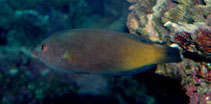
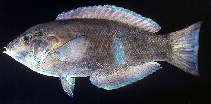
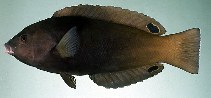
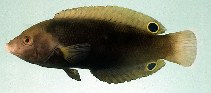
soft rays: 11 - 13. Color of Philippine `pterophthalmus' form very dark olive-brown; scales with reddish margins; body without markings. Male form (painting) reddish brown, each scale with a vertical blue line; irregular blue lines on head and thorax; median fins with spots or stripes and colored margins. Dorsal spines pungent. Caudal fin rounded in juveniles. Juveniles with large ocelli at the ends of the dorsal and anal fins (Ref. 48636).
Adults inhabit shallow coral reefs, often in weedy areas (Ref. 9710). Feed on benthic invertebrates. Expatriate juveniles are transported by currents to subtropical zones during pelagic stages (Ref. 48636). Oviparous, distinct pairing during breeding (Ref. 205). Occasionally seen in fish markets or aquarium trade.
Life cycle and mating behavior
Maturity | Reproduction | Spawning | Eggs | Fecundity | Larvae
Pelagic spawner (Ref. 32193). Oviparous, distinct pairing during breeding (Ref. 205). Protogyny was proposed but not confirmed (Ref. 103751).
Westneat, M.W., 2001. Labridae. Wrasses, hogfishes, razorfishes, corises, tuskfishes. p. 3381-3467. In K.E. Carpenter and V. Niem (eds.) FAO species identification guide for fishery purposes. The living marine resources of the Western Central Pacific. Vol. 6. Bony fishes part 4 (Labridae to Latimeriidae), estuarine crocodiles. FAO, Rome. (Ref. 9823)
IUCN Red List Status (Ref. 130435)
Threat to humans
Harmless
Human uses
Fisheries: minor commercial; aquarium: commercial
More information
ReferencesAquacultureAquaculture profileStrainsGeneticsElectrophoresesHeritabilityDiseasesProcessingNutrientsMass conversion
Tools
Special reports
Download XML
Internet sources
Estimates based on models
Preferred temperature (Ref.
123201): 24.6 - 29.3, mean 28.3 °C (based on 2750 cells).
Phylogenetic diversity index (Ref.
82804): PD
50 = 0.5002 [Uniqueness, from 0.5 = low to 2.0 = high].
Bayesian length-weight: a=0.00977 (0.00470 - 0.02030), b=3.07 (2.89 - 3.25), in cm total length, based on LWR estimates for this (Sub)family-body shape (Ref.
93245).
Trophic level (Ref.
69278): 3.5 ±0.50 se; based on food items.
Resilience (Ref.
120179): Medium, minimum population doubling time 1.4 - 4.4 years (Preliminary K or Fecundity.).
Fishing Vulnerability (Ref.
59153): Low vulnerability (21 of 100).
Nutrients (Ref.
124155): Calcium = 53.3 [32.7, 85.7] mg/100g; Iron = 0.589 [0.348, 1.061] mg/100g; Protein = 18.6 [15.7, 20.8] %; Omega3 = 0.135 [0.090, 0.201] g/100g; Selenium = 25.5 [16.2, 43.8] μg/100g; VitaminA = 113 [36, 394] μg/100g; Zinc = 1.4 [1.0, 2.2] mg/100g (wet weight);