Elasmobranchii (sharks and rays) >
Carcharhiniformes (Ground sharks) >
Pentanchidae (Deepwater catsharks)
Etymology: Haploblepharus: haplos (Gr.), single or simple; blepharon (Gr.), eyelid, referring to simple structure of lower eyelid, which closes against upper eyelid to protect the eye. (See ETYFish); edwardsii: In honor of English naturalist George Edwards (1694-1773), known as the “father of British ornithology,” who was the first to illustrate this shark, in 1760. (See ETYFish).
Environment: milieu / climate zone / depth range / distribution range
Ecology
Marine; demersal; depth range 0 - 130 m (Ref. 5510), usually 40 - 130 m (Ref. 5510). Subtropical; 29°S - 35°S
Southeast Atlantic: Cape Agulhas to Natal in South Africa. There are two different forms of this species, the 'Cape' and 'Natal' types, which differ in coloration and habitat and might be geographic variants or two distinct species (Ref. 6782).
Length at first maturity / Size / Weight / Age
Maturity: Lm ?, range 41 - ? cm
Max length : 59.0 cm TL male/unsexed; (Ref. 244); 60.0 cm TL (female)
Short description
Morphology | Morphometrics
Dorsal
spines
(total): 0;
Dorsal
soft rays
(total): 0;
Anal
spines: 0;
Anal
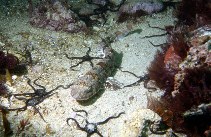
soft rays: 0. Southeastern Cape form: sandy brown with 7 reddish-brown saddles bordered by black, and numerous small, dark brown and white spots between saddles; white below (Ref. 5578). Natal form: body cream in color with darker brown saddles and irregular white spots; white below (Ref. 5578).
Found in inshore and offshore waters of the continental shelf, on sandy and rocky bottoms (Ref. 244). Feeds on bony fishes, crustaceans and cephalopods (Ref. 244). Oviparous (Ref. 50449). Caught by surf anglers (Ref. 244).
Oviparous, with 1 egg-case laid per oviduct (Ref. 244). Embryos feed solely on yolk (Ref. 50449).
Compagno, L.J.V., 1984. FAO Species Catalogue. Vol. 4. Sharks of the world. An annotated and illustrated catalogue of shark species known to date. Part 2 - Carcharhiniformes. FAO Fish. Synop. 125(4/2):251-655. Rome: FAO. (Ref. 244)
IUCN Red List Status (Ref. 130435)
Threat to humans
Harmless
Human uses
Fisheries: subsistence fisheries; gamefish: yes
More information
Age/SizeGrowthLength-weightLength-lengthLength-frequenciesMorphometricsMorphologyLarvaeLarval dynamicsRecruitmentAbundanceBRUVS
ReferencesAquacultureAquaculture profileStrainsGeneticsElectrophoresesHeritabilityDiseasesProcessingNutrientsMass conversion
Tools
Special reports
Download XML
Internet sources
Estimates based on models
Preferred temperature (Ref.
123201): 12.8 - 20.5, mean 16.3 °C (based on 24 cells).
Phylogenetic diversity index (Ref.
82804): PD
50 = 0.5625 [Uniqueness, from 0.5 = low to 2.0 = high].
Bayesian length-weight: a=0.00355 (0.00176 - 0.00714), b=3.09 (2.91 - 3.27), in cm total length, based on LWR estimates for this (Sub)family-body shape (Ref.
93245).
Trophic level (Ref.
69278): 3.8 ±0.3 se; based on diet studies.
Resilience (Ref.
120179): Very Low, minimum population doubling time more than 14 years (Fec assumed to be <10).
Fishing Vulnerability (Ref.
59153): Moderate vulnerability (44 of 100).
Nutrients (Ref.
124155): Calcium = 29.5 [4.8, 158.9] mg/100g; Iron = 0.746 [0.202, 2.212] mg/100g; Protein = 18.4 [15.3, 21.4] %; Omega3 = 0.195 [0.086, 0.425] g/100g; Selenium = 20.3 [6.1, 57.3] μg/100g; VitaminA = 11.3 [4.0, 31.8] μg/100g; Zinc = 0.647 [0.307, 1.195] mg/100g (wet weight);