Teleostei (teleosts) >
Eupercaria/misc (Various families in series Eupercaria) >
Lutjanidae (Snappers) > Etelinae
Etymology: Pristipomoides: Greek, pristis = saw + Greek, poma, -atos = cover, operculum + Greek, oides = similar to (Ref. 45335).
Environment: milieu / climate zone / depth range / distribution range
Ecology
Marine; reef-associated; depth range 90 - 360 m (Ref. 86942). Tropical; 31°N - 28°S, 93°E - 166°W (Ref. 55)
Pacific Ocean: southeastern Asia to Tahiti, north to the Ryukyu Islands, south to northeast Australia.
Size / Weight / Age
Maturity: Lm ? range ? - ? cm
Max length : 76.6 cm FL male/unsexed; (Ref. 107958); common length : 35.0 cm SL male/unsexed; (Ref. 9821); max. published weight: 3.0 kg (Ref. 125599)
Dorsal
spines
(total): 10;
Dorsal
soft rays
(total): 12;
Anal
spines: 3;
Anal
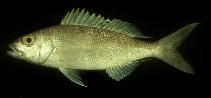
soft rays: 8. Interorbital space flat. Lower jaw slightly protruding. Bases of dorsal and anal fins without scales, their last soft rays extended into short filaments. Pectoral fins long, reaching level of anus. Scale rows on back running parallel to lateral line. Back and upper sides pale lavender or pinkish, grading to silvery ventrally. Head with dark spots on top. The margin of the dorsal fin yellow when fresh.
Adults occur over rocky bottoms; off Guam, caught most abundantly between 180-270 m (Ref. 9821). They feed primarily on benthic fishes and to a lesser extent on crustaceans, squids, and pelagic tunicates. Marketed mainly fresh.
Life cycle and mating behavior
Maturity | Reproduction | Spawning | Eggs | Fecundity | Larvae
Allen, G.R., 1985. FAO Species Catalogue. Vol. 6. Snappers of the world. An annotated and illustrated catalogue of lutjanid species known to date. FAO Fish. Synop. 125(6):208 p. Rome: FAO. (Ref. 55)
IUCN Red List Status (Ref. 130435)
Threat to humans
Harmless
Human uses
Fisheries: highly commercial
More information
ReferencesAquacultureAquaculture profileStrainsGeneticsElectrophoresesHeritabilityDiseasesProcessingNutrientsMass conversion
Tools
Special reports
Download XML
Internet sources
Estimates based on models
Preferred temperature (Ref.
123201): 14.8 - 23.1, mean 19.3 °C (based on 136 cells).
Phylogenetic diversity index (Ref.
82804): PD
50 = 0.5005 [Uniqueness, from 0.5 = low to 2.0 = high].
Bayesian length-weight: a=0.01479 (0.01109 - 0.01973), b=2.95 (2.90 - 3.00), in cm total length, based on LWR estimates for this species (Ref.
93245).
Trophic level (Ref.
69278): 3.6 ±0.51 se; based on food items.
Resilience (Ref.
120179): Medium, minimum population doubling time 1.4 - 4.4 years (K=0.27-0.36).
Fishing Vulnerability (Ref.
59153): Moderate vulnerability (39 of 100).
Nutrients (Ref.
124155): Calcium = 33.9 [19.9, 60.9] mg/100g; Iron = 0.538 [0.290, 0.888] mg/100g; Protein = 18.9 [17.0, 20.6] %; Omega3 = 0.169 [0.111, 0.268] g/100g; Selenium = 51.8 [32.2, 89.0] μg/100g; VitaminA = 64.6 [22.4, 199.4] μg/100g; Zinc = 0.966 [0.694, 1.360] mg/100g (wet weight);