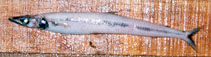
Teleostei (teleosts) >
Aulopiformes (Grinners) >
Notosudidae (Waryfishes)
Etymology: Scopelosaurus: Greek, skopelos = a lantern fish + Greek, sauros = lizard (Ref. 45335); harryi: Named after R.R. Harry, U.S. ichthyologist (Ref. 6885).
Environment: milieu / climate zone / depth range / distribution range
Ecology
Marine; bathypelagic; depth range 0 - 1500 m (Ref. 50550), usually 200 - 800 m (Ref. 43939). Deep-water; 60°N - 20°N, 121°E - 110°W
North Pacific: off Japan, throughout the California Current region (Ref. 35934) to the Aleutian Islands (Ref. 265); including Sea of Okhotsk and Bering Sea (Ref. 43939).
Size / Weight / Age
Maturity: Lm ? range ? - ? cm
Max length : 32.0 cm SL male/unsexed; (Ref. 43939)
Larger individuals apparently occur in deeper water than small ones (Ref. 4525). Synchronous hermaphrodites (Ref. 35934). Oviparous, with planktonic larvae (Ref. 35934). Juveniles makes nocturnal vertical migrations to the epipelagic zone (Ref. 43939). A planktivorous fish feeding mainly copepods and euphausiids (Ref. 35945).
Life cycle and mating behavior
Maturity | Reproduction | Spawning | Eggs | Fecundity | Larvae
Eschmeyer, W.N., E.S. Herald and H. Hammann, 1983. A field guide to Pacific coast fishes of North America. Boston (MA, USA): Houghton Mifflin Company. xii+336 p. (Ref. 2850)
IUCN Red List Status (Ref. 130435)
Threat to humans
Harmless
Human uses
More information
ReferencesAquacultureAquaculture profileStrainsGeneticsElectrophoresesHeritabilityDiseasesProcessingNutrientsMass conversion
Tools
Special reports
Download XML
Internet sources
Estimates based on models
Preferred temperature (Ref.
123201): 0.3 - 7.2, mean 3.4 °C (based on 266 cells).
Phylogenetic diversity index (Ref.
82804): PD
50 = 0.5001 [Uniqueness, from 0.5 = low to 2.0 = high].
Bayesian length-weight: a=0.00288 (0.00120 - 0.00692), b=3.18 (2.96 - 3.40), in cm total length, based on LWR estimates for this (Sub)family-body shape (Ref.
93245).
Trophic level (Ref.
69278): 3.1 ±0.0 se; based on diet studies.
Resilience (Ref.
120179): Low, minimum population doubling time 4.5 - 14 years (Assuming tmax>10).
Fishing Vulnerability (Ref.
59153): Low to moderate vulnerability (29 of 100).